Handwriting

At the Pegasus Academy Trust we teach children the skills to form letters correctly and join clearly and fluently. This supports all children in achieving the expected end of Key Stage 2 standard “Write neatly and maintain legibility in joined writing when writing at speed.”

Handwriting is an essential skill that supports the transcription and spelling element of the National Curriculum for English.  When teaching handwriting, it is important that good posture and an appropriate tripod pencil grip are encouraged.  Seating for left-handed pupils also needs to be considered to allow them to write without banging into the elbows of other children. These all form part of the ‘ready to write’ routine.

In the Reception, children follow the Little Wandle handwriting progression that interlinks with the teaching of phonics. The continuous provision provides ample opportunities for children to continue to develop their gross and fine motor skills that are so essential to handwriting.

From Year 1, children follow the Penpals handwriting progression that builds on the Little Wandle programme. In Year 1, children practise letter formation in letter families and are expected to form lower case letters, capital letters and numbers that are the right size and orientated correctly.  Letters should also be the correct size in relationship to one another.

In Year 2, most children are ready to begin to learn the joins and are introduced to diagonal and horizontal strokes to help them join some letters. Their writing should also use spaces between the words that reflect the size of their letters. In order to meet the expected standard for the end of Key Stage 1, children must meet these expectations.

In Years 3 and 4, children work on developing a fluent, joined and legible style of writing that enables them to write neatly at speed.  In Year 3, there may be some inconsistencies in letter formation and size but this should be consistent by the end of Year 4.  Many children will be ready to move to using pen during Year 4 and beyond by meeting the S criteria:

  1. Shape: Letters are formed correctly with the right starting and finishing points;
  2. Sitting on the line: The main bodies of the letters rest consistently on the baseline
  3. Size: Ascenders (tall letters) and descenders (tail letters) are clearly distinguished from x-height (short) letters;
  4. Space: Words have a clear, consistent space between them (roughly the size of one letter ‘o’)
  5. Stringing together (joining): The child has mastered the four basic join types and uses them automatically without stalling their thought process.
  6. Slant: The writing has a consistent angle (whether vertical or slightly forward-slanted).
  7. Speed & comfort: The child can write for a sustained period without experiencing hand fatigue or pain.

In Years 5 and 6, children will begin to develop a slanted style that aides them to write fluently and at greater speed, preparing them for transition to secondary school. In order to meet the expected standard for Key Stage 2, children must write neatly and maintain legibility when writing at speed.

Please click here for videos showing the Penpals letter formations

Handwriting in the Early Years and Foundation Stage (EYFS)

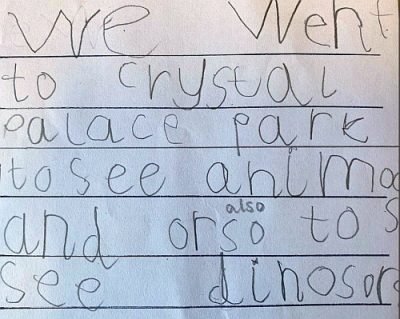
The end of year expectation for reception children is that they can hold a pencil effectively using a tripod grip to form recognisable letters, most of which are correctly formed. This is a strong example of this as it is legible and demonstrates good pencil and letter size control. Most letters are formed correctly but there are inconsistencies with the descender letters that should sit on the line with the tail below the line.  Most children will be printing their letters in the EYFS.
End of Year 1 expectations

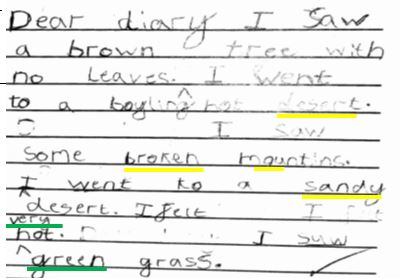
This is a good example of Year 1 handwriting as all the letters are formed using the correct orientation.  Capital letters are formed correctly and there are clear finger spaces between the words.
End of Year 2 expectations

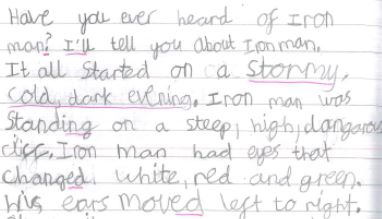
In this example, we can see how the child has developed from Year 1.  They are beginning to join some letters to help their writing flow.  At this stage, letter sizing may be inconsistent as the child begins to learn to join. Children in Year 2 need to produce handwriting of this standard in order to meet the Key Stage One expected standard in writing.  Pegasus elements like loops on the letters ‘f’ and ‘g’ are clearly discernible.
End of Year 3 expectations

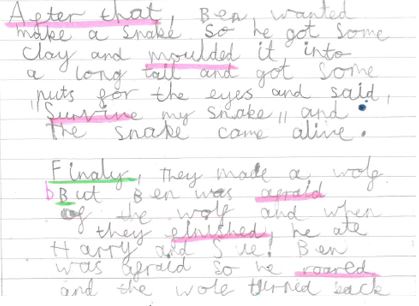
In Year 3, the child has progressed to joining all letters as a matter of course.  Capital letters are used correctly and not joined.  There are still some inconsistencies in letter sizing as the child becomes familiar with joining multiple letters.  Handwriting is legible and flows well across the page and children at this stage are generally fitting more words per line.
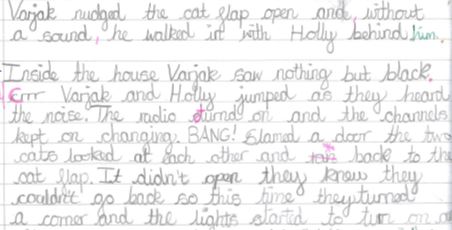
End of Year 4 expectations

In Year 4, the child has progressed to ensuring writing is neat, fluent and joined. Letter sizes are consistent and work is neat and clear. Neat, clear handwriting is also used when the child has ‘pink pen edited’ their work to make improvements.
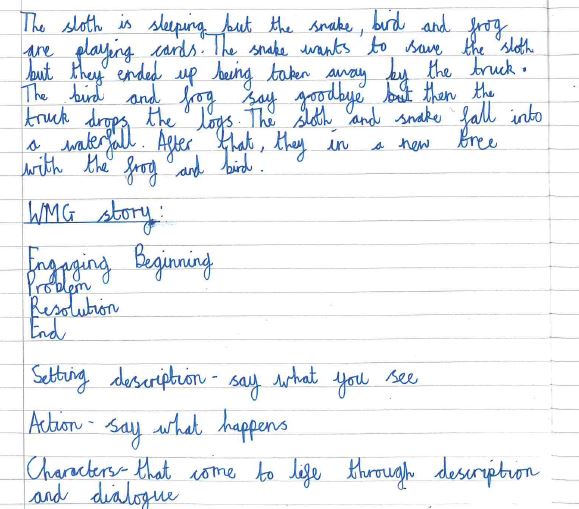
End of Year 5 expectations

In Year 5, the child has progressed to using a more personal style.  Handwriting is still neat, joined and fluent but the child is making personal adaptations to their writing that allow them to write at speed.
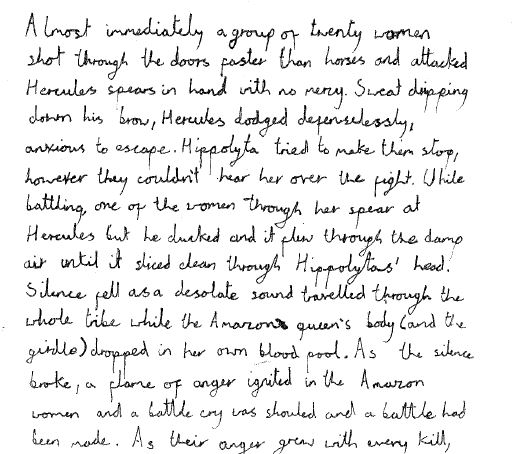
End of Year 6 expectations

In Year 6, writing is joined, neat and legible and children use a personal style that means they can write at speed. The child will consider when it is best to join a letter and when it is quicker not to.  Children in Year 6 must produce neat, joined and fluent writing in order to meet the expected standard in writing for the end of Key Stage 2.

First published on 9th January, 2019 and modified 15th July, 2026

Scroll for more! Continue
Close
Translate
Choose Language:
Close
Share: